Cooler than 2010, according to world's media
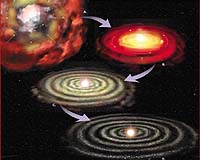
“Ever”? Really? What hotter than when the planets coalesced from a swirling disk of white hot stellar matter 4.5 billion years ago? Well no, of course not. But the media regularly make nonsensical statements like this because they haven’t a clue about history, or any concept of time.
What they mean is “since about 150 years ago.” The fact that 2010, like 1998, was a major El Niño year, and therefore tells us very little about what global temperatures are really doing, is of no consequence. It is likely that 2011, influenced as it will be by a strong La Niña, will be significantly cooler. But there will be wall-to-wall excuses for that – “just a blip”, “warming will resume faster than evah next year” – because a cooling blip is just a blip, whereas a warming blip is evidence of man-made global warming. Add that to a slow recovery from the depths of the Little Ice Age over the past 200 years means that it is almost inevitable that each decade will be warmer than that preceding it.
However, the media’s love of scare stories and the gullibility of the general public ensures that idiotic headlines like this go largely unchallenged.
Both the ABC and Fairfax (natch) fall into the trap of demonstrating their ignorance of any concept of history by copying the same headline from AFP:
Fairfax: 2010 warmest ever year, says UN weather agency
ABC: 2010 officially the hottest year ever
The articles go on to cover much the same ground (but always remember, the WMO is a body operating under the auspices of the UN, just like the IPCC, which, as any fule kno, is little more than a corrupt mouthpiece for a bunch of politically-motivated environmental activists):
The UN’s World Meteorological Organisation said Thursday that 2010 was the warmest year on record [at least they say “on record” here, but they don’t go on to explain that means 150 years, or 50 atoms across on the Age of Earth Ruler – Ed], confirming a “significant” long-term trend of global warming and producing exceptional weather variations.
The trend also helped to melt Arctic sea ice cover to a record low for December last month, the WMO said in a statement. [Nobody ever mentions the Antarctic of course, because that end of the planet isn’t playing ball – Ed]
Last year “ranked as the warmest year on record, together with 2005 and 1998,” the WMO added, confirming preliminary findings released at the global climate conference early December that were based on a 10-month period.
“The 2010 data confirm the Earth’s significant long-term warming trend,” WMO Secretary-General Michel Jarraud said. “The 10 warmest years on record have all occurred since 1998.”
Which is like saying the 10 warmest days this year happened since the end of winter. Shock. It says nothing about the cause – we all know the cause (it’s the Green Climate Monster). But that doesn’t stop typical “cracked record” remarks from the Grantham Institute’s Bob Ward, wading in for no other purpose other than to bash sceptics (and alarmists are much better at bashing sceptics than they are at playing by the rules of science, like actually sharing their data and models for example):
“Self-proclaimed climate change ‘sceptics’ may still try to claim that global warming stopped in 1998, but they cannot explain away the fact that nine of the 10 warmest years on record have all occurred since 2000,” said Bob Ward, of the Grantham Research Institute on Climate Change and the Environment at the London School of Economics (LSE).
“Self-proclaimed”? And what’s with the quotes around ‘sceptics’? Following that lead you’re a self-proclaimed ‘alarmist’ whose livelihood is funded by the climate scare, then? Actually most sceptics don’t claim warming stopped in 1998, I certainly don’t. 1998 is a poor year to choose because of the large El Niño spike, but I would suggest that temperatures (as measured by satellite, rather than the fudged and homogenised surface records) have been largely static since about 2002. But of course Phil Jones of CRU previously went as far as to say that there has been no statistically significant warming since 1995…
But it’s all meaningless. None of this says anything about the cause, and that’s really all we’re interested in.


 Australian Climate Madness
There’s a couple of other things they like to leave out:
Only one dataset (GISS) says 2010 is the warmest year on record. HadCRUT, RSS and UAH have 2010 lower. HadCRUT has long been touted by alarmists as a reliable data source, so why are they not making headlines about the disagreement of their dataset?
2010 in GISS is highest by 0.01 of a degree, or an order of magnitude less than the error bars, thus making the claim totally meaningless.
Alarmists ability to leave out important facts in order to make a story scarier could be mistaken for an inability of rational thought.
I am confused Simon I thought 1998 was still the hottest on record is this not correct.??
As Dave N points out above, only GISS makes 2010 the warmest, by the tiniest of margins.
Hi Simon,
Again, although I agree with the point you are trying to make, I have to disagree with your overstatement on this matter:
We are interested in the cause of no warming?
The temperature trend not following the CO2 follows the null hypothesis and is therefore hardly meaningless. It’s more appropriate to say “Who cares?” about the cause when the data shows no significant effect.
I listened to you radio interview, very impressive. Here it is again for anyone who didn’t catch it. The download speed is slow:
http://www.mtr1377.com.au
I agree with your point, and again, I am probably being a little too flippant. But it is meaningless whether 1998 or 2010 was warmer – both are El Niño years, and we cannot tell anything useful about the decadal trend from comparing them.
Thanks for your comments on the interview – I couldn’t find it on the MTR website – they only put up the audio for Adam Bandt… but I recorded it and it’s on the ACM media page, and YouTube.
“they only put up the audio for Adam Bandt”
Hmmm, speaking of flippancy…….
Actually global warming stopped when the alarmists started calling it climate change.
Keith said:
Which is why we should avoid using the term, “climate change”. We assist them when we do that. When they employ, “climate change”, in their aplogetics for, let’s say, the brutal cold in the northern hemisphere, we should say, “You mean Global Warming?”. Then they’re stuck with either saying it isn’t Global Warming or explaining the reason for the verbal prestidigitation.