Where's the acceleration?

No matter what happens to the climate between now and the publication of the IPCC's 5th Assessment Report, we can be sure that the alarmism will be ratcheted up to ever more preposterous heights to keep the research funds flooding in. Everything will be bigger, faster, badder, worse than we thought, quicker than we thought etc, etc. The IPCC, and thousands of climate scientists, are too dependent on the "global warming" scare to let it go without a fight. And it's started already. The IPCC's AR4 predictions for sea level rise were exaggerated enough, but AR5 will be worse:

THE world's peak scientific body on climate change [I think not] will ''almost inevitably'' make an increase in its predictions of sea-level rises due to global warming in its next landmark report in 2014, the vice-chair of the UN's Intergovernmental Panel on Climate Change says.

Jean-Pascal van Ypersele told The Age recent satellite observations showed extensive melting in the Greenland and Antarctic ice sheets.

That new data will be considered in the IPCC's next assessment report - regarded by governments and scientific groups as the world's pre-eminent scientific document on climate change - and should lead to an increase in predictions of sea-level rises, Professor van Ypersele said.

The sea-level rises estimated in the IPCC's last assessment report, released in 2007, were now on the low side. [See, what did I just say? It's all bigger, badder, faster]

That report put sea-level rises at 18 to 59 centimetres above 1990 levels by 2100.

Members of the IPCC met in Kuala Lumpur last week to discuss the consideration of the Greenland and Antarctic data for the IPCC's next report - its fifth. Analysis of the extent of reduction in mass of the two major ice sheets will be the report's main focus.

''The reason there was a workshop in KL is that the IPCC knows very well this is an area that needs particular attention and where a lot of progress has been made,'' Professor van Ypersele said.

New satellite data ''are starting to show - but are quite convincing, I must say - that both the Greenland ice sheet and the Antarctic ice sheet are losing net mass, not on the margins but as an ice sheet'', he said.

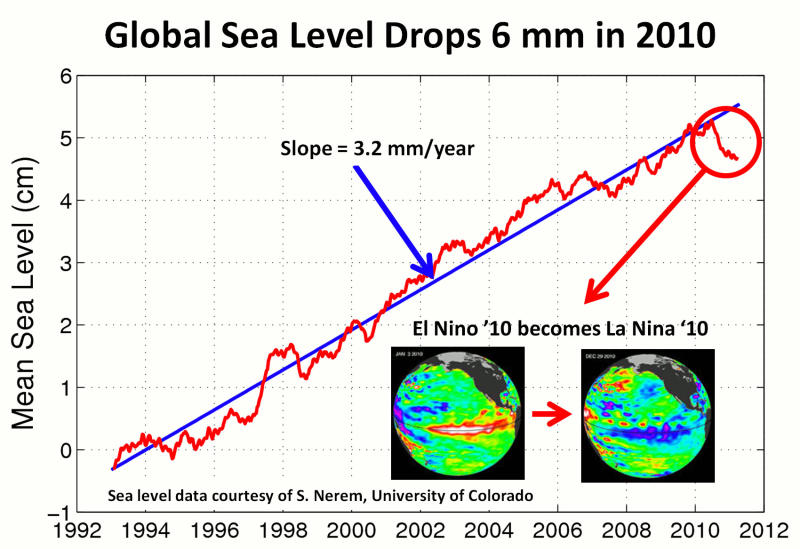
Funny that the sea level record shows no acceleration of sea level rise, despite attempts to show otherwise.

Strap yourselves in, folks, it's gonna be one hell of a ride.

Read it here.

The game's up

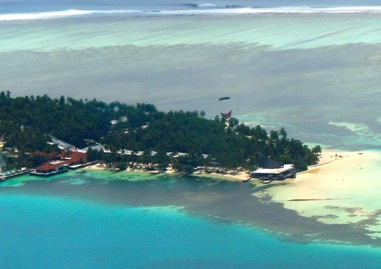
I love it when a story like this comes along - I couldn't have scripted it better myself. After the wailing and whinging from the Pacific islands at every climate conference about how "sea level rises" are going to sink their homes and that we need to transfer billions of dollars in climate aid, we discover that the islands are actually … increasing in size! The ABC is shocked, shocked I tell you, that yet another disaster in the waiting cannot be pinned on climate change any more:

Climate scientists have expressed surprise at findings that many low-lying Pacific islands are growing, not sinking.

Islands in Tuvalu, Kiribati and the Federated States of Micronesia are among those which have grown, largely due to coral debris, land reclamation and sediment.

The findings, published in the magazine New Scientist [ouch, I bet that hurt], were gathered by comparing changes to 27 Pacific islands over the last 20 to 60 years using historical aerial photos and satellite images.

Auckland University's Associate Professor Paul Kench, a member of the team of scientists, says the results challenge the view that Pacific islands are sinking due to rising sea levels associated with climate change.

"Eighty per cent of the islands we've looked at have either remained about the same or, in fact, gotten larger," he said.

"Some of those islands have gotten dramatically larger, by 20 or 30 per cent.

"We've now got evidence the physical foundations of these islands will still be there in 100 years."

Dr Kench says the growth of the islands can keep pace with rising sea levels.

"The reason for this is these islands are so low lying that in extreme events waves crash straight over the top of them," he said.

"In doing that they transport sediment from the beach or adjacent reef platform and they throw it onto the top of the island."

Barry Brook, well known climate alarmist, is shocked, shocked, I tell you:

"Sea levels are obviously rising - I think in the short term [the study] suggests that there's maybe more time to do something about the problem than we'd first anticipated," he said.

"But the key problem is that sea level rise is likely to accelerate much beyond what we've seen in the 20th century."

Ah yes - your flaky computer models tell you that I guess? Well, take a look at the actual sea level measurements for a change, and you will see that they doing nothing unusual whatsoever - rising by a few millimetres a year like they have since the end of the last Ice Age - despite the "global warming" we have apparently had for the last 150 years.

But the people of the Pacific islands are not likely to give up their "climate debt blank cheque" in a hurry, so they're doing some quick work to sweep all this under the carpet:

Naomi Thirobaux, from Kiribati, has studied the shape of Pacific islands for her PhD and says no-one should be lulled into thinking erosion and inundation is not taking its toll and displacing people from their land.

"In a populated area what would happen was that if it's eroding, a few metres would actually displace people," she said.

"In a populated place people can't move back or inland because there's hardly any place to move into, so that's quite dramatic."

Both Dr Kench and Dr Brook and scientists agree further rises in sea levels pose a significant danger to the livelihoods of people living in Tuvalu, Kirabati and the Federated States of Micronesia.

Sorry - doesn't wash any more. Go to the back of the queue.

Read it here.

Nearest tide gauge - less than 1 mm per year…

Although you surely wouldn't believe it by reading the mainstream media, trumpeting as they are the fact that an "island" has disappeared because of rising sea levels "caused by climate change". The Sydney Morning Herald does a brilliant job of getting it all wrong:

In an unusual example of the effects of global climate change, rising sea levels in the Bay of Bengal have helped resolve a troublesome territorial dispute between two of the world's most populated countries, a leading Indian oceanographer says.

Sugata Hazra, the head of oceanography at Kolkata's Jadavpur University, says a flat muddy patch of land known as South Talpatti in Bangladesh and New Moore Island in India has disappeared under the Bay of Bengal. The landmass had been claimed by both countries but Professor Hazra says satellite images prove it has gone.

''It is now a submerged landmass, not an island,'' Professor Hazra told the Herald.

''Only small parts can be seen in very, very low tide conditions.''

Sea-level rise caused by climate change was ''surely'' a factor in the island's inundation, Professor Hazra said.

''The rate of sea-level rise in this part of the northern Bay of Bengal is definitely attributable to climate change,'' he said.

''There is a close correlation between the rate of sea-level rise and the sea surface temperature.''

The island was once about 3.5 kilometres long and three kilometres wide and situated four kilometres from the mouth of the Hariabhanga River, the waterway that marks a stretch of the border between south-western Bangladesh and India.

Scientists believe the disputed island was formed following a cyclone in the Bay of Bengal in 1970 and both countries laid claim to the land. (source)

Right, so what's the reality? It's not an island, as in a rocky outcrop, it's a sand bar. As the article says, it was created following a cyclone just 40 years ago. It is in an estuary, an area of rapid erosion and deposition. "Islands" such as this are being created and destroyed on a regular basis all the time. Look at the sea level rise from the nearest official gauge - just 0.54mm per year.  Whatever caused this sandbar to disappear, it sure as hell wasn't "climate change."

Thanks to Anthony Watts.

Pure science fiction

From The Science is Settled Department. The UK Guardian [staggers back in amazement - Ed] reports that scary predictions of sea-level rises in a Nature paper have been withdrawn, with the author admitting to "mistakes":

Scientists have been forced to withdraw a study on projected sea level rise due to global warming after finding mistakes that undermined the findings.

The study, published in 2009 in Nature Geoscience, one of the top journals in its field, confirmed the conclusions of the 2007 report from the Intergovernmental Panel on Climate Change (IPCC). It used data over the last 22,000 years to predict that sea level would rise by between 7cm and 82cm by the end of the century.

At the time, Mark Siddall, from the Earth Sciences Department at the University of Bristol, said the study "strengthens the confidence with which one may interpret the IPCC results". The IPCC said that sea level would probably rise by 18cm-59cm by 2100, though stressed this was based on incomplete information about ice sheet melting and that the true rise could be higher. [Isn't it strange that they didn't say "it could be lower" as well? Cynics may say that shows evidence of bias… - Ed]

Many scientists [alarmists - Ed] criticised the IPCC approach as too conservative, and several papers since have suggested that sea level could rise more [If you torture the data long enough, it will confess - Ed]. Martin Vermeer of the Helsinki University of Technology, Finland and Stefan Rahmstorf of the Potsdam Institute for Climate Impact Research in Germany published a study in December that projected a rise of 0.75m to 1.9m by 2100.

Siddall said that he did not know whether the retracted paper's estimate of sea level rise was an overestimate or an underestimate. [But I bet we can guess which he hoped it was - Ed]

And then the poor chap does his best to put a brave face on it (three times):

  • "It's one of those things that happens. People make mistakes and mistakes happen in science."
  • "Retraction is a regular part of the publication process."
  • "Science is a complicated game and there are set procedures in place that act as checks and balances."

Read it here. (h/t Climate Change Fraud)

Only the purple is below sea level

Clog-gate? Windmill-gate? Edam-gate? Yet another error in IPCC AR4, this time relating to sea levels in Holland:

A United Nations report wrongly claimed that more than half of the Netherlands is currently below sea level.

In fact, just 20 percent of the country consists of polders that are pumped dry, and which are at risk of flooding if global warming causes rising sea levels. Dutch Environment Minister Jacqueline Cramer has ordered a thorough investigation into the quality of the climate reports which she uses to base her policies on.

Climate-sceptic MPs were quick to react. Conservative MP Helma Neppérus and Richard de Mos from the right-wing Freedom Party want the minister to explain to parliament how these figures were used to decide on national climate policy. "This may invalidate all claims that the last decades were the hottest ever," Mr De Mos said.

The incorrect figures which date back to 2007 were revealed on Wednesday by the weekly Vrij Nederland. The Dutch Environmental Assessment Agency told reporters that the UN's Intergovernmental Panel on Climate Change (IPCC) added together two figures supplied by the agency: the area of the Netherlands which is below sea-level and the area which is susceptible to flooding. In fact, these areas overlap, so the figures should not have been combined to produce the 55 percent quoted by the IPCC.

The discovery comes just a week after a prediction about glaciers in the Himalayas proved wrong. Rather than disappearing by 2035, as IPCC reports claim, the original research underlying the report predicted the mountain ice would last until 2350. (source)

The Dutch environment minister isn't impressed:

Dutch Environment Minister Jacqueline Cramer says she will no longer tolerate errors by climate researchers. She expressed her anger to Dutch researchers who presented their annual report on the state of the climate on Wednesday. (source)

Can you imagine Penny Wong having the guts to say the same? No, me neither, because she, like Rudd and Co, is blinded by dogma.

More "no warming"

From The Science is Settled Department. But, but, but, everyone knows the sea is warming - it must be, our models say so:

SEA water under an East Antarctic ice shelf showed no sign of higher temperatures despite fears of a thaw linked to global warming that could bring higher world ocean levels, first tests showed yesterday.

Sensors lowered through three holes drilled in the Fimbul Ice Shelf showed the sea water is still around freezing and not at higher temperatures widely blamed for the break-up of 10 shelves on the Antarctic Peninsula, the most northerly part of the frozen continent in West Antarctica. [Gee, maybe the break up of the ice shelves was caused by something else, perhaps? Surely the scientists didn't rush to blame global warming, did they? - Ed]

"The water under the ice shelf is very close to the freezing point," Ole Anders Noest of the Norwegian Polar Institute wrote after drilling through the Fimbul, which is between 250m and 400m thick.

"This situation seems to be stable, suggesting that the melting under the ice shelf does not increase," he wrote of the first drilling cores.

The findings, a rare bit of good news after worrying signs in recent years of polar warming, adds a small bit to a puzzle about how Antarctica is responding to climate change, blamed largely on human use of fossil fuels [by the media and alarmist scientists, that is - Ed].

Read it here.

Dec 112009
Day 4

Day 4

As was to be expected, the climate talks are boiling down to a China vs US punch-up. Yesterday, the US negotiator was blunt about the need for China to play ball, and today China has hit back, calling for more emissions cuts from the US (and more money, naturally):

China's top climate envoy called on President Barack Obama to increase a U.S. offer to cut greenhouse gases, and said it would discuss a 2050 emissions goal only if rich nations offered more cash and carbon cuts.

Xie Zhenhua said developed nations must commit to cuts of "at least 40 percent" by 2020 from 1990 levels. He said Beijing was aiming for a legally binding treaty from the December 7-18 talks, although hosts Denmark have said that will be impossible.

A successful outcome from the summit largely depends on agreement between the United States and China, which together generate 40 percent of global carbon emissions.

But negotiations have been bogged down for months by rifts between developed and developing nations over who should cut emissions, by how much, and who should pay.

"I do hope that President Obama can bring a concrete contribution to Copenhagen," Xie said in a rare interview.

Asked if he meant something more than Obama has proposed so far, a 3 percent cut from 1990 levels by 2020, Xie said: "Yes."

"The whole world is watching the United States, and as long as they take on a good leadership role, then I think that we can make a large step forward in combating climate change." (source)

40% by 2020 on 1990 levels equates to economic suicide, just sayin'. Meanwhile, in Faifax fantasy land, the Sydney Morning Herald prints the story of a 17-year-old living in the Solomon Islands, who pleads that her home is being flooded "by climate change":

I am 17 years old. For my entire life, countries have been negotiating a climate agreement. My future is in front of me. In the year that I was born, amid an atmosphere of hope, the world formed the United Nations Framework Convention on Climate Change to solve the climate crisis.

This week I told negotiators at the main plenary session of the UN Climate Change Conference that time is running out and my generation needs them to work together to come up with the agreement that we deserve.

Sea-level rise and unprecedented storm surges caused by climate change are already affecting communities across the Pacific and are expected to get significantly worse if climate change is not immediately and adequately tackled.

Consequently, small island governments, like my own, are asking the global community to prevent global warming above 1.5 degrees. This means a global emission stabilisation target of below 350 parts per million of carbon dioxide equivalent in the atmosphere.

Maybe she hasn't seen this graph, which shows sea levels rising at a constant rate, which they have done since the end of the last Ice Age, and which are actually slowing down:

Can't hide the decline

Can't hide the decline

Sarah Palin speaks the truth about the whole Copenhagen gab-fest:

SARAH Palin all but declared global warming a hoax yesterday when the former US vice-presidential candidate urged Barack Obama to boycott the Copenhagen climate change conference and stand up to the "radical environment movement".

The former Alaska governor and possible 2012 presidential contender seized upon leaked emails from climate change scientists at the University of East Anglia. The scientists have been accused by sceptics of falsifying data to make the case that the phenomenon is real and man-made, something they deny.

The scandal has become a cause celebre among climate change deniers and sceptics. A group of Republican politicians has vowed to fly to Copenhagen next week to argue that the threat from global warming is overblown and too costly to act on.

Writing in The Washington Post, which was criticised from the Left for allowing her to argue her case [gee, that sounds like an attempt at censorship. Why would that be? The Left are always in favour of full and open debate, aren't they? - Ed], Mrs Palin said: "The revelation of appalling actions by so-called climate change experts allows the American public to finally understand the concerns so many of us have articulated on this issue." (source)

Well said.

And in other news, an wholly undeserving person receives a totally discredited prize somewhere and makes long speech. Yawn.

The Wong-bot

The Wong-bot

Curious, isn't it, that CSIRO choose to release dire warnings about the effects of sea level rises of 1.1m by 2100 just before the Senate is due to debate the ETS, giving the Wong-bot the perfect opportunity to threaten the Coalition with apocalyptic consequences if the ETS isn't passed. The Wong-bot denies that it's a scare campaign (well, she would, wouldn't she) but I think the evidence speaks for itself:

As a result, the report says, more than $60 billion worth of residential property faces flooding.

In addition 120 ports, 1,800 bridges, power stations, water treatment plants and airports close to the coastline are also under threat.

Climate Change Minister Penny Wong says the findings can't be ignored.

"The science tells us our climate is changing faster than first projected and the impacts are likely to be more severe," she told reporters in Sydney.

Australia must immediately reduce its carbon emissions, she said.

"Which is why we are determined to pass the Carbon Pollution Reduction Scheme."

OK then, Penny. Let's work this through the twisted logic of this, shall we?

Question 1: Assuming the two-errors-in-four-words Carbon Pollution Reduction Scheme (ETS) is passed and Australia cripples its economy and reduces its emissions by, say, 20% by 2020, what effect will that have on sea level rises around Australia?

Answer: Nothing, because Australia produces less than 1.5% of global emissions.

Question 2: Assuming that at Copenhagen, the rest of the developed world is so impressed with Australia's brand new, shiny ETS that they all fall over themselves to cripple their economies too, and sign a treaty reducing emissions significantly by 2020, what effect will that have on sea level rises around Australia?

Answer: Nothing, because increased emissions from China (who are building a new coal fired power station every week) and India (who have more important things to worry about, like tackling poverty and disease - you know, stuff that really does kill people) will more than make up for any cuts by developed countries. Plus, the developed countries will begin to realise that running a developed economy on sunbeams and fart-power ain't as easy as they thought, so targets will simply not be met.

Question 3: Assuming that China and India miraculously reduce their emissions as well, what effect will that have on sea level rises around Australia?

Answer: Almost certainly nothing, for the same reasons as above, and also since CO2 is unlikely to be revealed as the main driver (or even one of the main drivers) of "global warming".

Question 4: Assuming that CO2 is the main driver (or one of the main drivers) of "global warming", what effect will the ETS and/or the Copenhagen treaty have on sea level rises around Australia?

Answer: Nothing, because just like the Kyoto Treaty, which even if fully implemented would have reduced global temperatures by about three and a half gazillionths of a degree, the Copenhagen treaty will have no discernible effect on the climate whatsoever.

Scare campaign? You decide. Why on earth the Coalition are even bothering to negotiate is quite frankly beyond my comprehension.

Read it here.

Rising faster than ever?

Rising faster than ever?

Garbage In Garbage Out Alert: This is the sort of nonsense one gets when one treats as gospel the projections of hopelessly incomplete models. Even the IPCC thinks that sea level rises will only reach 79cm, but Australia's own alarmist CSIRO goes one better. It has chosen the figure of 1.1m (how?) as the figure to base yet further modelling on the effects to our coastal fringes, and (phew!) comes up with suitably alarmist results which will get printed in every paper in the country. Why not choose 1.5m or 2m? Surely they can find a model that predicts that?

Almost 250,000 homes, now worth up to $63 billion, will be "at risk of inundation" by the end of the century, under "worst-case but plausible" predictions of rising sea levels.

The study -- released ahead of the crucial Senate vote on Labor's emissions trading scheme -- modelled the effect of a 1.1m sea-level rise on cities and towns around Australia.

This is a higher level than the 79cm end-of-century rise predicted by the last Intergovernmental Panel on Climate Change, but in the mid-range of some subsequently published research.

It found between 157,000 and 247,000 homes "at risk of inundation" -- meaning they would be permanently flooded or frequently flooded by storm surges or king tides -- with hospitals, water-treatment plants and other public buildings also found to be at risk.

Even Sydney airport would be at "increased risk" of inundation, according to the study, written by the Department of Climate Change with input from CSIRO, Geosciences Australia and scores of academics.

Andrew Ash, director of the CSIRO climate-change adaption flagship, said the 1.1m sea-level rise was "certainly plausible".

"As things stand, the only variation will be exactly when we reach that level," Dr Ash said.

So that could be in 2100, 2500, 3000, then? Climate nonsense.

Read it here.

It will be interesting to see what the sceptic community makes of this:

New Zealand scientists say massive ice shelves are protecting Antarctica from experiencing the same rapid decline in sea ice as the Arctic.

The research team says the discovery further debunks the claims of sceptics who have pointed to the continent's growth as evidence against global warming.

The team was led by Otago University physics researcher Andrew Mahoney, who said the eight-month study focused on a topic scientists understood little about.

Dr Mahoney said findings would help climate scientists make predictions about the future.

National Institute of Water and Atmospheric Research oceanographer Mike Williams said the research explained why Antarctic sea ice was not decreasing at a similar rate to that of the Arctic.

Figures from America's National Snow and Ice Data Center show that Arctic sea ice shrank by about 4 per cent of 500,000 square kilometres each decade during the past 30 years. By contrast, Antarctic sea ice was not believed to have changed much in size and may have increased slightly.

However, Antarctic Research Centre director Tim Naish, who was not part of the research team, said the latest data issued in a report by Nasa indicated that the amount of Antarctic sea ice lost since 2003 could have doubled.

WHAT THE SCIENTISTS FOUND

  • Massive ice shelves make up half the Antarctic coastline
  • Cold water melts from these ice shelves
  • The melted water protects the ice sheets from the warming effects of climate change
  • This causes ice sheets to grow in winter, although they still melt in summer
  • This is why Antarctic sea ice has not declined as quickly as Arctic sea ice in response to global warming

Read it here.

UPDATE: Tim Naish is also in the news for predicting dramatic sea level rises:

Sea levels may rise an average of as much as 1.5m by 2100, the latest figures show.

The range indicated by several new studies is between 50cm and 150cm, said Dr Tim Naish, director of the Antarctic Research Centre at Victoria University in Wellington, New Zealand.

A glaciologist who was chief scientist on a major Antarctic drill-core project, Naish said the latest "range of plausible sea level rise" was based on observations to calculate how much water would come from polar ice sheets.

Read it here.